
Reducing Risk for Storytellers
Jurgen “jojo” Appelo
Stories are products, whether storytellers like it or not. This reality becomes evident when we compare the divergent strategies of two renowned authors: J.K. Rowling and E.L. James.
J.K. Rowling’s 2012 novel, The Casual Vacancy, was highly anticipated due to her Harry Potter fame. Despite extensive media coverage and high initial sales, it received mixed reviews for its darker themes and failed to achieve long-term popularity. With average ratings of 3.6 on Amazon and 3.3 on GoodReads, the book was essentially a dud. Since then, Rowling has struggled to maintain her previous success.
In contrast, E.L. James found immense success with her “Fifty Shades” trilogy, which began as “Twilight” fan fiction. Her provocative content and compelling storytelling, initially shared as short stories, went viral and captivated a vast readership. Strategic use of social media and word-of-mouth marketing further boosted the series’ popularity. While her follow-up novels haven’t matched this success, James is credited with creating a whole new genre (billionaire romance), whereas Rowling merely popularized an existing theme (fantasy schools).
These contrasting experiences offer valuable lessons for aspiring storytellers.
The Product Manager’s Perspective
Some storytellers resist viewing their publications as products, preferring to see them as pure art. However, if we want our stories to be consumed and enjoyed, we must manage them like any other product. In essence, storytellers are product managers of their narratives.
Product management extends beyond creation; it involves managing various risks to increase the chances of success. The number of ways stories can fail mirrors the pitfalls faced by other product types. Even successful authors often stumble. To mitigate these risks, we can turn to a well-established model in product innovation.
The DFV Model: A Tool for Risk Reduction
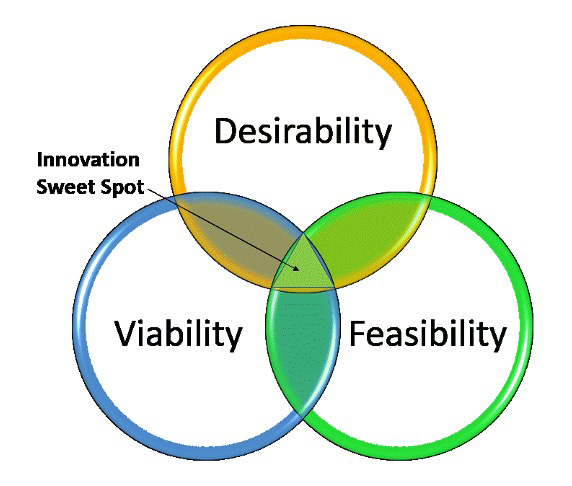
Image: Kristann Orton
The Desirability, Feasibility, and Viability (DFV) model, attributed to Tim Brown of IDEO, offers a framework for reducing risk in product innovation. By addressing these three crucial areas, storytellers can improve their odds of success.
- Desirability – Does your story resonate?
Desirability gauges whether people are interested in your story. Smart product managers validate desirability early on.
As a storyteller, you can test desirability before publication through alpha readers, peer review groups, or by sharing short stories for feedback, as E.L. James did. She refined her work based on reader response, while Rowling appears to have skipped this step. The lesson? Validate early that people enjoy your work.
For instance, with my novel Glitches of Gods, I validated the story by telling it to friends before my writing began. This allowed for immediate feedback and identification of strengths and weaknesses in my narrative.
- Feasibility – Can you deliver your story?
Feasibility concerns the capabilities needed to realize your vision. For storytellers, this means assessing whether you have the time, talent, and discipline to complete your project.
Did you know that 99% of writers never finish their first book? To validate feasibility, set aside regular writing time, establish targets, and maintain a sustainable pace. The key lesson: don’t start writing if you can’t even finish.
In my case, a disciplined approach involved allocating specific writing time and tracking my productivity in a spreadsheet. Receiving early positive feedback from editors and beta readers provided confidence in my ability to finish the novel. These steps reduced the chance of failing at feasibility.
- Viability – Can your story sustain you?
Viability addresses whether your product can generate sufficient value—in other words, can it pay the bills? For storytellers, this means considering various revenue streams beyond traditional publishing advances.
Options include royalties, subscriptions, advertising, and freelancing. The question is: which business model suits you best? The lesson here is to figure out early how to sustain yourself as a storyteller.
My own approach in this is three-tiered: Short-term income from workshops and public speaking engagements, mid-term revenue from a paid newsletter, and (hopefully) long-term income from royalties on my books. By diversifying my revenue streams, I try to reduce the chance of failing at viability.
Applying the DFV Model to Storytelling
The Desirability, Feasibility, and Viability model applies to storytellers as much as it does to other product managers. After all, a story is just another product. We should reduce the risk of writing stories nobody wants to read, stories we can’t finish, and stories that won’t pay our bills.
Note that some product innovation experts have suggested extensions to the DFV model, such as Usability, Adaptability, Scalability, Availability, Sustainability, Inclusivity, and Morality. While these are worth exploring for storytellers, I want to save them for another time.
Most of us may never achieve the level of success seen by J.K. Rowling and E.L. James, but we can learn from both their triumphs and missteps. By adopting product management strategies like the DFV model, we can significantly reduce the risk of publishing a dud and potentially uncover our own path to storytelling success. There are countless ways to fail with stories, but by focusing on desirability, feasibility, and viability, you’re already ahead of the game.
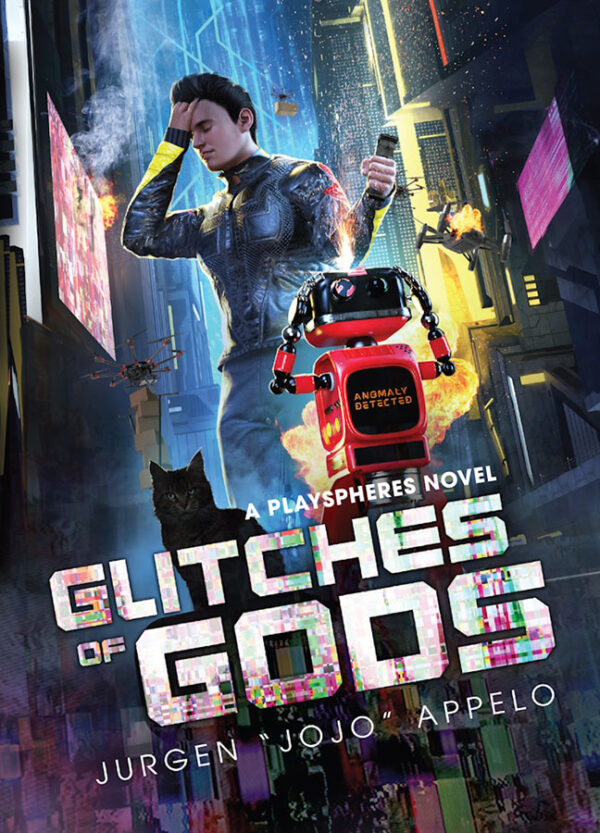
Julien, the AI genius, craves freedom, but the gods wield total control. In this ominous world, will his android bring hope and salvation or yet more death and destruction?
Julien feels utterly miserable. Creator of the AI that killed his father, the brilliant engineer deftly evades work on the world’s first human-level android, dodging the off-chance of snuffing out more lives. Instead, Julien much prefers bickering with his virtual assistant, crafting memes with his quirky friends, and shagging dates across a broad spectrum of genders. Yet, due to a maddening jump across timelines, he grudgingly faces his greatest dreads: raising a family and leading his team to win the AI race.
Drowning in new duties, Julien aims to avoid a second AI disaster. But when a mysterious, technological infection wreaks havoc on the city, Julien flip-flops between shielding his loved ones and leading his team as he battles it out with broken machines, idiot protestors, and a rather sinister cat. Learning he got himself involved in a war between gods, should Julien save his new family or finish his team’s android to prevent an AI apocalypse?
Glitches of Gods is the extraordinary first book in the Playspheres epic science fantasy series. If you like cynical sentients, wacky worlds, and plenteous profanity, then you’ll love the kick-off of Jurgen Appelo’s bewildering saga.
Universal Buy Link
Amazon

Jurgen is giving away a $20 Amazon gift card with this tour:

“There are one hundred and twenty-three messages—”
“Shut up, Orec—”
An anguished shout startled him. Julien barely had time to sidestep an older woman who speed-walked past at a pace that didn’t seem entirely natural. He watched as she yelled and gestured at other people before vanishing among the trees, leaving a trail of agitated pedestrians in her wake. Half-expecting a sonic boom to follow, Julien wondered if the lady’s impressive pace was entirely voluntary. A malfunctioning bodymod, perhaps? But then, a hideous sticker on a nearby lamppost drew his attention.
Reject suppression.
Reject secrecy.
Reject slavery.
Reject AIs.
#Wetwares
Gods, did Burt put this here? The Wetwares movement online was annoyingly outspoken about the dangers of AI, but this was Julien’s first encounter with an actual physical sticker—and an appalling one, too. It looked like it was designed in a traffic accident. I’ll ask Burt about it tomorrow.
“Orec, is there something to eat at home?”
“The available food items in the kitchen do not sufficiently meet the recommended minimum when considering standard dietary intake.” Julien let that pass for a moment, and then Orec added, “You’ll be hungry and grumpy.”
“I’ll grab something nearby, then.” Julien knew a food stall at the edge of the park. “Any dating prospects for tonight, Orec?”
“You have twelve invites; seven of them identify as women, three as men, two as genderqueer, one transgender, one bi-gender, one pangender, one agender, one novigender, and one intergender.”
Julien’s mind performed some calculus. “That makes eighteen, not twelve.”
“The person identifying as pangender also identifies as agender and genderqueer.”
“What about the other genderqueer?”
“They identify as man, woman, and intergender.”
“That would be trigender, then.”
“They may not identify as three genders when they also identify as genderqueer.”
“What about the bi-gender person? Are they the same as the transgender?”
“No, the bi-gender person identifies as a woman and novigender.”
“By the gods. And the transgender?”
“They identify solely as a woman.”
“Well, I’m glad one of them keeps it simple.”
“What preference are you leaning toward tonight?”
“Who cares about gender? Just give me tits. I’m in the mood for tits today—any gender. Gods, if I were straight, I’d save hours on the matching rituals.”
“I count another ‘fallacy of oversimplification.’”
“Nobody cares, Orec. Nobody cares.”
Julien wound his way between the trees and walked around the lake. The flyers he’d spotted earlier were now boarding passengers while children swam, splashed, and laughed in the water. Nearby, a standard Class 3 robot, looking like the outcome of a stirring union between C-3PO and a Cyberman, stood with its feet just shy of the lake’s edge, holding a pile of towels. Poor guy—or girl. One day, you will drop everything and dive right in with the others. You may even desire a swimsuit.
Ten minutes later, Julien was in a heated exchange involving his Turkish pizza. “So, credit cards don’t work; debit doesn’t work; Gitcoin doesn’t work; Kurrenzee doesn’t work; Swipe doesn’t work; Europay doesn’t work, and XDollar doesn’t work.” He cocked his head. “Where’d you get your payment systems? At a garage sale in Pyongyang?”
The woman—assuming she identified as such—offered an apologetic shrug. Exasperated, Julien rummaged through his pockets and slammed a few coins on the counter. Thank the gods for cash. He snatched the food and, making a show of his boundless frustration, walked off without saying another word. The entire universe is conspiring against me.
With some effort, he spotted a cast-iron park bench that wasn’t occupied, hurried over to claim it, and settled down. He laid his jacket beside him and grumbled under his breath as he unwrapped his meal.
“Gods, Orec. It’s 2054, and we still need cash.” He savored a bite of the rolled-up pizza, the flavors of spiced meat, cheese, garlic, and hot sauce tingling in his mouth. After swallowing, he continued, “I’m telling you, fifty years from now, we’ll have a hundred different ways of not being able to pay. And we’ll be surrounded by these ‘Wetwares’ zealots convinced that super-intelligent AIs use these technical problems to drive us all nuts and enjoy a good laugh.”
Orec remained silent.
Oh, here we go again. “What’s bothering you, Orec?”
“I detect no problems with my performance or functionalities.”
“That’s not what I asked.”
Orec resumed his silence.
Julien sighed. “I know you, Orec. I helped to create you. You don’t like it when I complain about the sad state of AIs; you don’t like my work on Tweeki, and you don’t like the possibility of Tweeki surpassing you.” He paused for a moment. “Plus, Tweeki has a body.”
“I wish you hadn’t decommissioned me,” said Orec.
“I wish you hadn’t killed people,” answered Julien.
There was no time to wait for a response. A piercing screech from overhead assaulted Julien’s ears, and mere moments later, less than a stone’s throw away from where he sat, the grass erupted, and a shock wave rattled the trees when a flyer crash-landed into the ground.


Jurgen likes coffee, books, games, and people leaving him alone when he’s being creative.
Author Website: https://jurgenappelo.com/
Author Facebook (Personal): https://www.facebook.com/jurgenappelo/
Author Instagram: https://www.instagram.com/jurgenappelo
Author Goodreads: https://www.goodreads.com/author/show/4462627.Jurgen_Appelo
Author Amazon: https://www.amazon.com/stores/Jurgen-Appelo/author/B00460MCJM