Reviewed by: Sue Eaton
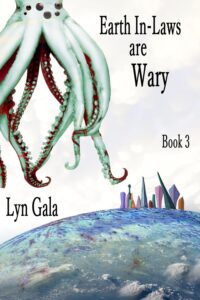 TITLE: Earth In Laws Are Wary
SERIES: Earth Fathers #3
AUTHOR: Lyn Gala
PUBLISHER: Self Published
LENGTH: 189 pages
RELEASE DATE: January 27, 2026
BLURB:
Max and Rick are travelling space with three children and one human friend they’ve promised to take home. They’ve overcome language barriers, confused surrogacy contracts and attacks from hostile aliens. And that includes political attacks and prejudice in addition to pirates boarding their spaceship.
But now the children want to see their home planet and Rick is getting stranger every second they draw near the Hidden world. Max knows his belchy husband well enough to know something is wrong, but nothing would prepare him for the political and familial disaster waiting for them. This time, circumstances may pull their little family apart at the seams.
REVIEW:
Earth In‑Laws Are Wary is the moment the series looks at Max and Rick’s happily chaotic little family and says, “Wonderful. Now let’s add secrets, politics, and in‑laws who could start a war with a raised eyebrow.” It’s deliciously messy in all the right ways.
The emotional core of the book is Max discovering Rick’s dark secret one that isn’t just personal but tied to the very foundations of Rick’s species and their political structure. It’s the kind of revelation that could have shattered a weaker relationship, but instead it becomes a crucible. Max doesn’t retreat; he recalibrates. He processes the shock, the betrayal, the implications and then he does what Max always does: he chooses Rick, even when Rick struggles to choose himself. Their bond deepens into something steadier, more adult, more “we’re in this together even when it’s awful.”
Meanwhile, the children continue to be tiny geniuses with the impulse control of caffeinated squirrels. Their development is both hilarious and unsettling brilliant, intuitive, and already showing signs that they might outpace both their parents and half the political leaders on Rick’s home world. They’re not just comic relief anymore; they’re becoming players in the story’s larger arc, whether they mean to or not. Their curiosity, empathy, and sheer alien‑human hybrid oddness force Max and Rick to confront what kind of future they’re building.
They go to Rick’s home world because, in the end, avoiding it becomes more dangerous than facing it. Rick’s misgivings are loud, he knows the political landscape is a nest of vipers, he knows his past is tangled in secrets he never wanted Max to see, and he knows that bringing their hybrid children into that environment is like tossing matches into a fireworks factory. But circumstances, threats from outside forces, questions about the children’s future, and the growing need to confront the power structures that keep trying to manipulate their family. Max, ever the pragmatist, recognises that running only cedes ground to their enemies. They go not because Rick feels ready, but because Max refuses to let fear or politics dictate their lives. They arrive as a united front, determined to claim space, demand answers, and show Rick’s world that this odd little family is not something to be hidden or exploited, but something worth standing up for.
The political landscape of Rick’s home world equal parts ancient tradition, power games, The ceremony to honour Rick where everyone involved wishes they were literally anywhere else, yet they’re all too polite, too political, or too stubborn to leave. It’s stiff, formal, and dripping with cultural expectations that makes Max itch under the collar. Rick is trapped in the centre of it like a prize bull on display admired, scrutinised, and subtly judged by every faction with an agenda. Max clocks the power plays instantly: the veiled insults, the territorial posturing, the way certain dignitaries treat Rick like an asset rather than a person. The kids, of course, are seconds away from causing a diplomatic incident by being their brilliant, feral little selves. The family navigates the whole ordeal like a covert operation. Max positions himself at Rick’s side, intercepting manipulative conversations, redirecting political predators, and quietly threatening anyone who gets too close with the kind of smile that says, “I will ruin your day.” Rick leans on Max’s instincts, the children cling to their dads, and together they turn an uncomfortable spectacle into a united front awkward, tense, but undeniably theirs.
Rick’s progenitor sits at the centre of his home world’s political machinery like a spider in a web silent, calculating, and disturbingly patient. Every thread of influence seems to run back to them, whether through tradition, or the quiet pressure of expectation. They watch Rick with a kind of clinical fascination, as if assessing whether this wayward creation of theirs will fall neatly into place or snap the strands, they’ve so carefully woven. Max feels the weight of that gaze immediately; he recognises a power player when he sees one, and this one doesn’t even bother to hide the manipulation. Navigating their presence becomes a delicate dance: Rick trying not to flinch under the burden of legacy, Max subtly cutting through the sticky political threads, and the children brilliant, unpredictable, and entirely unimpressed, threatening at any moment to tug the whole web down.
The book digs into identity, inheritance, and the uncomfortable truth that Rick’s past is not as clean as he wanted Max to believe. Navigating those politics requires Max’s sharp instincts and Rick’s honour, but also a willingness to redefine what family means when biology, culture, and cloning blur the lines.
The result is a story that blends emotional revelation with political intrigue, all anchored by the fierce, funny, deeply loyal love that Max and Rick have built. It’s a book about secrets coming to light, children growing into their brilliance, and a family learning to stand strong in a world that doesn’t quite know what to make of them.
RATING: 
BUY LINKS:
