Reviewed by: Sue Eaton
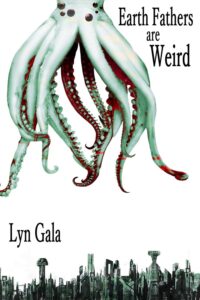 TITLE: Earth Fathers Are Weird
SERIES: Earth Fathers #1
AUTHOR: Lyn Gala
PUBLISHER: Self Published
LENGTH: 221 pages
RELEASE DATE: April 13, 2019
BLURB:
Captain Maxwell Davis and his entire unit scrambled to engage alien ships over Iowa. The aliens snatched him out of his destroyed jet before they continued on their interplanetary hot pursuit. Then they informed Max that Earth was too far outside regular shipping lanes to return him to his planet.
So Max ends up in an alien spaceport looking for work. To afford a ticket home he can either spend three hundred years working with linguists to improve the computer’s questionable ability to translate English or he can take a job as a nanny for an unpopular alien. That way he can afford the ticket in four years. The problem is that the computer may have mistranslated the word “nanny” and there might be a reason an alien is willing to pay such a high fee.
REVIEW:
Earth Fathers Are Weird is the kind of story that starts as a cosmic misunderstanding and quietly transforms into a found‑family romance with teeth, scales, and a surprising amount of heart. Max, a stranded human pilot who thinks he’s been hired as an interstellar nanny, and Rick, an alien warrior who thinks he’s secured a surrogate, stumble their way into partnership through cultural confusion, accidental intimacy, and a shared determination to protect the tiny lives they bring into the world. What begins as a bizarre contractual arrangement becomes a tender, awkward, deeply funny journey toward trust and connection.
Max is just trying to survive being scooped up by aliens like a confused housecat. He’s stranded, injured, and very much not briefed on interstellar HR policies. When Rick a giant, scaly, earnest alien and operating on a solid 12/10 on the “I have no idea how humans work” scale asks him to be a surrogate, Max hears “Nanny. Babysitter. Childcare professional. Sure, I can do that.” What Rick actually means is “Please gestate my child in your body, tiny soft human.” The misunderstandings begin immediately and do not stop.
Max is the human embodiment of “I did not sign up for this, but I guess I’m doing it anyway.” He’s sarcastic, stubborn, and deeply practical, the kind of man who can be abducted by aliens, dumped on a strange planet, and still worry about whether he’s being paid fairly for childcare. He’s got that customer‑service‑survivor grit: he adapts fast, he questions everything, and he refuses to be treated like he’s fragile, even when he absolutely is. Underneath the snark, though, he’s loyal, unexpectedly nurturing, and far more emotionally open than he realises. He’s the heart of the relationship, even when he’s pretending, he’s just there for the job.
Rick is the sweetest disaster. He’s trying so hard to be respectful, but his cultural knowledge of humans is basically that humans are small; are squishy; need food; and sometimes explode emotionally. He approaches Max like Max is a very fragile important diplomatic egg. Rick thinks he’s being clear. Max thinks Rick is weirdly intense for a boss. Rick is a giant, scaly cinnamon roll with the communication skills of a well‑meaning brick. He’s earnest, honourable, and so determined to do right by Max that he overcorrects into “protective alien mode” at every turn. His worldview is shaped by duty, biology, and a culture that does not map neatly into human expectations, so half his interactions with Max are him trying to translate feelings into actions and getting it adorably wrong. But he’s gentle, patient, and absolutely devoted. Once he decides Max is his partner he commits his whole being.
The Surrogacy Plot is a comedy of biological errors. It’s the kind of misunderstanding that would be horrifying in real life but is peak entertainment because Max handles it with sarcasm, stubbornness and the emotional resilience of someone who has worked customer service.
The charm of this book is watching two people who fundamentally do not understand each other… try anyway. They bond over survival, parenting, Max’s refusal to die despite Rick’s constant expectation that he might and Rick’s absolute devotion, which he expresses like a man trying to translate love through Google Translate set to ‘intergalactic’. Somewhere between the medical procedures, cultural confusion, and “wait, are we… dating?” moments, they become a family. Their dynamic is a slow, steady collision of misunderstandings, affection, and mutual awe. Max teaches Rick how to loosen up; Rick teaches Max what it feels like to be valued. They start as two beings fumbling through a bizarre arrangement, and end up as a family built on trust, care, and the kind of love that grows in the quiet moments between crises.
An emotional turning point in the book, sneaks up on you because the book has been juggling comedy, cultural confusion, and Max’s ongoing “why is my life like this” energy. Then suddenly we’re in this moment of pure, instinctive connection. The children are born, everything ridiculous and chaotic between them just… quiets. Max, who has spent the whole book feeling out of place and out of his depth, finds himself grounding Rick instead, steadying this massive, battle‑hardened alien who is suddenly terrified and overwhelmed by the tiny lives arriving in front of them. Rick, who has been so careful and so convinced Max is fragile, looks at him like he’s witnessing something miraculous. And Max, who thought he was just doing a job, realises he’s already emotionally tethered to this strange little family they’ve built. It’s tender, awkward, and unexpectedly intimate: two beings from different worlds, both stunned by the enormity of what they’ve created together.
By the end of the book, it’s less about aliens and more about two very different beings choosing each other, learning, fumbling, and building a family in the most unexpected corner of the galaxy.
RATING: 
BUY LINKS:
