Reviewed by: Sue Eaton
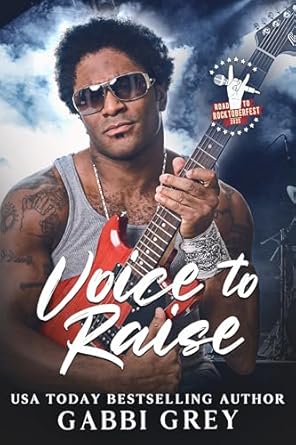 TITLE: Voice to Raise
SERIES: Road to Rocktoberfest 2025
AUTHOR: Gabbi Grey
PUBLISHER: Self Published
LENGTH: 260 pages
RELEASE DATE: October 8, 2025
BLURB:
Malik
Until I turned twenty-five, I took the safe route, the good boy route. Played with the orchestra, kept my head down, didn’t make waves. Now I can’t stay silent any longer. I walked away from my violin, relearned the guitar, and started a rock band. With Razor’s Edge, I can create the music I’ve always dreamed of, and we’re good enough to win an invite to Rocktoberfest. But I also love my band for helping me raise my voice to support social justice. Now I just need to convince Spencer I can chase musical success and still be deeply committed to making a difference.
Spencer
I’ve been fighting for justice practically from the cradle, and I believe organizers should welcome everyone who wants to be involved. That said, when an upstart rockstar looking for the limelight comes to join our fight, I’m skeptical. I want true believers, not people who are looking to leverage our cause into a viral hit. Malik might be gorgeous, and even a sweet guy under the tattoos and bad boy persona, but he’s chasing his dream of fame in Black Rock while I’m on the ground in Vancouver trying to make meaningful change. He doesn’t have room in his life to be serious about music, serious about justice, and serious about me.
REVIEW:
This book is a deliciously defiant, emotionally charged opposites-attract romance that throws glitter, guitars, and social justice into a blender, and somehow makes it taste like queer liberation with a side of drywall repairs.
Malik former child protégé orchestra darling turned tattooed rebel with a cause. Ditches his violin for a guitar and forms Razor’s Edge, a rock band with a social justice backbone. Passionate, idealistic, and just the right amount of chaotic energy to make Spencer’s spreadsheets tremble.
Malik’s childhood was a masterclass in repression, he played it safe, stayed quiet, and followed the “good boy” script all the way to the orchestra pit. But that silence? It simmered. By the time he hit twenty-five, the lid blew off. Malik spent his youth in the classical music world, playing violin and toeing the line. He was quiet, obedient, and deeply closeted, emotionally and politically. That environment taught him discipline but also stifled his voice, both literally and metaphorically. Walking away from the orchestra wasn’t just a career pivot, it was a personal revolution. Years of silence made Malik acutely aware of the cost of staying quiet. His transformation into a rockstar wasn’t just about fame, it was about finally being loud, proud, and unapologetically himself. Activism gave him purpose; music gave him the mic.
Spence was an activist since birth; he came out of the womb holding a protest sign. Fiercely committed to meaningful change, allergic to performative allyship. He has zero patience for fame-chasers, especially ones with cheekbones sharp enough to cut through his cynicism.
Spencer’s childhood was basically a boot camp for activism, minus the medals, plus a lifetime supply of righteous fury. He grew up steeped in social justice, practically raised on protest chants and policy briefs. But here’s the twist: that early exposure didn’t just make him passionate. It made him exhausted surrounded by causes, campaigns, and the emotional toll of fighting uphill battles. He learned early that not everyone who shows up is there for the right reasons. Performative allyship? He’s seen it. Burnout? He’s lived it. When you’ve spent your formative years watching people use movements for clout or abandon them when things get hard, you develop a sixth sense for BS. Spencer doesn’t just want help, he wants commitment. And Malik, with his tattoos and fame-chasing vibe, sets off every alarm bell in Spencer’s activist brain.
Malik crashes into Spencer’s activist world like a glitter bomb at a climate march. He’s loud, proud, and determined to prove that music and justice aren’t mutually exclusive. Spencer, meanwhile, is side-eyeing Malik so hard he’s spraining his cornea. But beneath the snark and suspicion, there’s undeniable chemistry, think “accidental kiss during a heated debate” levels of tension.
Their connection is built through shared goals, late-night strategy sessions, and the kind of emotional vulnerability that only comes after someone’s patched your drywall and seen you cry over a broken megaphone.
Spencer is all about grassroots activism, boots-on-the-ground change. Malik rolls in with tattoos, a guitar, and a dream of Rocktoberfest stardom. Spencer sees Malik as a fame-chaser. Malik sees Spencer as gatekeeping the revolution. Their early interactions are basically verbal sparring matches with sexual tension humming underneath.
Malik joins Spencer’s activist group, forcing them into close quarters. Cue late-night strategy sessions, drywall repairs, and moments where Spencer catches Malik being genuinely passionate. Spencer’s armor starts to crack, but he’s terrified of being wrong about Malik and even more terrified of being right. Malik wants Spencer to believe in him not just as a musician, but as a partner in justice and love. Spencer keeps pulling away, convinced Malik can’t be serious about all three: music, activism, and him. Every step forward (a kiss, a confession, a shared cause) is followed by a step back (doubt, distance, denial).
Spencer doesn’t believe Malik’s activism is genuine. Malik’s fighting to prove he’s more than a pretty face with a guitar. Spencer’s skepticism isn’t just intellectual, it’s protective. He’s been burned before, and Malik’s dream of balancing music, justice, and romance feels like a fantasy with a high risk of heartbreak.
So, when Malik says, “I can be serious about music, justice, and you,” Spencer hears: “I’m about to disappoint you in three different ways.” And yet… he wants to believe.
The climax isn’t just about Rocktoberfest, it’s about whether Malik can prove he’s in it for the long haul. Spencer must decide: is he protecting the movement or just protecting his heart. Their dynamic is a delicious mix of “I hate how much I want you” and “I don’t trust you, but I can’t stop hoping.” It’s hurt/comfort with a side of snark, and the payoff is pure queer joy.
RATING: 
BUY LINKS:
