Three historical novels by Jeffrey Buchanan
💜Sucking Feijoas 💜The Smile of the Dispossessed 💜Pansies’ Revenge
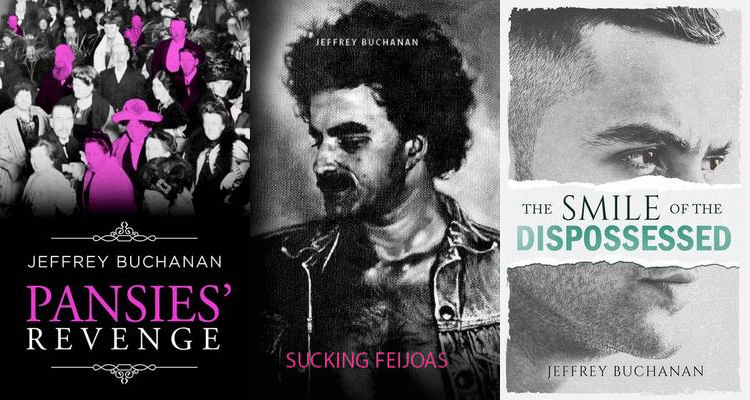
💜Sucking Feijoas 💜The Smile of the Dispossessed 💜Pansies’ Revenge
BOOK 1
Book Title: Sucking Feijoas
Author: Jeffrey Buchanan
Publisher: https://lgbtqipressnz.com
Cover Artist: FormattingExperts.com
Length: 283 pages
Release Date: June 24, 2020
Genre: Gay Historical novel, LGBTQI Literary / Historical Fiction
Themes: gay liberation, coming out
It is a standalone story.
Buy links
Universal Link | Amazon US | Amazon UK

Blurb
George thinks he’s a real man…until he is seduced by an American serviceman on duty in New Zealand during WW2.
Neddy, the son of Lebanese migrants, marries a peasant girl in an attempt to overcome his attraction to men.
Garth, an intellectual, working-class Catholic boy, escapes to Mexico but eventually returns to reveal a painful secret.
Set in New Zealand, Lebanon and Mexico between 1942 and 1986, SUCKING FEIJOAS follows the lives of gay men and how, with ingenuity, courage and love, they managed their lives – despite the odds. Now in its third edition, this deeply engaging story about sexuality, class, race and the culture wars that surrounded them, is as relevant as ever. SUCKING FEIJOAS is riveting storytelling, gay history, empowering.
Excerpt
George was ecstatic that the party was going to be held in what he now referred to as his apartment. ‘Flat’ was definitely out as a term of reference to his abode now that he had such wonderful and sophisticated friends as Garth Griffin and Neddy Berdawni. He looked around his living room, a haven of peace and loveliness, which would soon be the scene of the wild party he’d planned in honour of the passing of the Homosexual Law Reform Bill.
‘All’erta! All’erta!Abb’etta zingara! he sang in a falsetto accompaniment to the opera blasting from his stereo. ‘All’erta.’ He lifted the needle from the record and put it back a few grooves so that he could again hear the soprano rejoicing in his favourite refrain from Il Trovatore. ‘All’erta! All’ertd! Abb’etta zingara!’
Food was displayed on the Formica table in his kitchen. It looked glorious, the madeira cake and the stuffed mushrooms. But best of all was that fabulous Arabic concoction with the name he had the same difficulty in pronouncing as the frantic refrains from the opera.
‘All’erta!’ he sang as he sniffed Neddy’s hummus. ‘Amazing,’ he said, ‘it feels so good to be able to sing opera without thinking it might get me arrested. Us poor, poor queens, for so many centuries denied our pleasures!’
On the wall in front of him was a picture of Mount Taranaki, which he stared at as he reached into a cupboard for the bottle of sherry. The huge, handsome flanks of that monstrous mountain. So many decades of admiring it. So many tortures endured in its presence, each like the ice axes that climbers stuck in the flanks of that wily old mountain.
‘And there you still are.’ He saluted the mountain. ‘And me too,’ he said as he downed a mouthful of the deliciously sickly sherry. ‘Still alert, still surviving.’
He bent over the table and stuck his finger in the delicious dip he’d come to adore since Neddy had first made it for him. ‘Hmmmm, hmmiss, homos, oh something or other,’ he said in a pickled hiss. He licked his finger with the creamy substance smeared over it and closed his eyes in satisfaction.

BOOK 2
Book Title: The Smile of the Dispossessed
Author: Jeffrey Buchanan
Publisher: https://lgbtqipressnz.com
Cover Artist: FormattingExperts.com
Length: 313 pages
Release Date: March 19, 2020
Genre/s: Gay historical romance
Themes: LGBTQ refugees
It is a standalone story.
Buy Links
Universal link |Amazon| Website | Book Depository
Blurb
“The Smile of the Dispossessed” is a love story and a political thriller set in Iraq, Jordan, Lebanon, Malaysia and Indonesia. The novel tells the story of Fadhi and Adam who flee Baghad in the final days of the Saddam Hussien regime when they are ‘outed’ as being gay and accused of being enemies of the state. Despite having been lovers for many years, under the pressures of being refugees, they separate and go their own ways, both men hoping to find freedom in a country that will accept them for who they are. “The Smile of the Dispossessed” demonstrates the enduring requirement to maintain faith in humanity and the power of love.

CHAPTER 1
Baghdad
Fadhi Janabi was tall and handsome and within a city struck by pov- erty he wore his clothes with an unusual elegance. His jacket was styled from photos in a French magazine and his mother had tailored it from material meant originally for Uncle Mukhtar’s wedding suit. Now, as he walked quickly down the littered Baghdad avenue, Fadhi asked his Uncle Mukhtar: “Who will it be who fires the bullet into my brain? What is the name of the man who will slice up my body as they did yours?”
The sun was weak and therefore pleasant as it crawled through the late Spring sky. Fadhi passed the mosque with the turquoise dome where a group of men dressed in long white dishdasha argued under a concrete shelter that soldiers used when there were disturbances in the city. The shrill voices of the men squabbling in their Baghdad accents were accentuated by their anger. Fadhi avoided their eyes and wished he too were wearing a grubby dishdasha and a headscarf, the long folds of which would allow him more cover in a city where eyes and voices were all subject to innuendo and open for interpretation. His clean white shirt was a beacon for the poor to assess and his mauve silk tie from Paris felt more like a noose.
Fear went crawling up his arms and into his face and hair and the sweat seeped out and left a patina of wet as if he had been drizzled on. At the next corner, under the dilapidated sign for a delicatessen that no longer contained its elite merchandise, stood two men dressed in the ill-fitting and shabby Western clothing of men confused by their class. Fadhi walked towards them as he stifled the urge to turn and go back up the street to his home and avoid the screening eyes and the dangers inherent in being different in a city of spies and hatreds. But to have turned would have invited even more suspicion than the cut of his suit or the Parisian tie or the clean shirt with the fashionable collar. Everything was a clue, a bright innuendo. He had the impulse to rip off his precious tie and throw it in the rubbish that stank in the gutter beside him as the full significance of his colleague’s accusation ripened and festered. Instead of turning left to arrive at Adam’s apartment house, he continued straight ahead to ensure he was not being followed there. At the tobacconists he paused as if to survey what merchandise there was in the window.
“There’s always tobacco under a dictatorship,” he thought. “Economic sanctions can’t disrupt the supply of nicotine.” Then he shook his head, drew in a deep breath and relaxed the muscles in his shoulders: “I’ll go mad if I don’t control this,” he thought. “God, please help me.” He turned and retraced his steps to the corner and walked quickly down the narrow side street and took the key from his pocket without checking if he were being followed because suddenly he didn’t care. It didn’t matter. Strength had entered him and he thanked God for the power of prayer and forgiveness. Nothing could get him, not the confusion of what was happening to him or his country, not the paranoia. He went up the stairs and called out: “Adam, it’s me, Fadhi.”
Adam Dawisha was twenty-seven, ten years younger than his lover. When Fadhi entered, he was in the kitchen heating coffee: “I knew you’d be here at exactly four,” he said, turning from the small gas appliance, and smiling at Fadhi. “I felt it in my heart.” The smell of coffee and the weak light sifting through the doors from the balcony that highlighted Adam’s body in his light blue dishdasha shifted the tensions within Fadhi. For a few seconds something akin to happiness wafted in him – delicate, sweet, beautiful – like a covering of icing sugar sifted over something bitter. The two men remained silent; in that moment there was nothing that needed to be said for it was all there between them, that essence, that feeling. The sweetness continued as the seconds ticked on the kitchen clock. As Fadhi traced the outline of Adam’s body through the diaphanous material he felt that familiar warm feeling slide through him.

BOOK 3
Book Title: Pansies’ Revenge
Author: Jeffrey Buchanan
Publisher: https://lgbtqipressnz.com
Length: 305 pages
Release Date: April 22, 2020
Genre/s: LGBTQI Historical / Literary fiction
Literary novel about the LGBTQI community set in Wellington, New Zealand in 1918 during the Spanish Flu.
It is a standalone story.
Buy Links
Amazon US | Amazon UK | Book Depository
Blurb
A vibrant, entertaining, often darkly Gothic story is filled with passion, love, pathos, farce and humour. Pansies’ Revenge lays bare the political, social and cultural fabric of New Zealand society at a pivotal time in the nation’s history. Set in 1918 the novel explores what it was like to resist political oppression and at the same time, face a global pandemic.
It is late 1918 and in Wellington, New Zealand, four years of world war and the ravages of the Spanish flu are taking their toll on the inhabitants.
All are not for King and Country. The members of the Te Aro book club: queer, feminist, bohemian, disgruntled, are accused of sedition for reading Crime and Punishment and drawing from it the roots of the problems facing the world. The more intently they read, the more the crazed characters of the book appear to manifest themselves in Wellington.
Intrigues deepen: Cecil and Sybil Meatyard, who work the crowds to a frenzy of patriotism in the streets of Wellington for the New Zealand Women’s Anti-German League, disappear. Their diatribes about war shirkers, spies and Pansies have upset a lot of people. The sinister Crawford Denton, detective and sensualist, follows the case. A 1918 MeToo Movement begins as the influenza pandemic takes hold.
This vibrant, entertaining, often darkly Gothic story is filled with passion, love, pathos, farce and humour. Pansies’ Revenge lays bare the political, social and cultural fabric of New Zealand society at a pivotal time in the nation’s history.

Chapter One
Alexander Powderham, fortyish, handsome, bohemian, limped his way up Cuba Street. His left leg, having been crippled from infantile paralysis, was supported by a steel brace. He was dependent also on canes, of which he had an impressive collection, and on this occasion, he was using one intricately carved by Aroha Raharuhi, his longtime lover.
The air was unseasonably warm for mid-September Wellington, which heightened the smell rising from the mounds of horse ordure left from the morning’s military parade. Outside the Duchess Tea Rooms, Alexander paused and rested on his good leg while he adjusted his recently tailored jacket, smoothing down the Irish linen with his hands, delighting in its texture and colour of golden flax. Then he adjusted his silk tie, cream coloured with charcoal flecks, loosening the knot a little at the undone top button to ensure that rakish look, which was one of casual elegance. The white, Egyptian cotton shirt had also been crafted especially for him by the clothiers Munster & Munster who, through four years of war, had survived patriotic vandalism by hanging a large sign across their shop windows, WE ARE NOT HUNS: WE SUPPORT KING AND COUNTRY. Alexander’s chocolate brown, wide-brimmed hat with a duck’s feather poking from the green woven band was also avant-garde, of a high-quality felt and based on a design he had seen in a fashion weekly from London.

Jeffrey Buchanan was born in Wellington, New Zealand, to a Lebanese – New Zealand family. For thirty years, including a decade with the United Nations, he worked in multiple countries in education, the promotion of human rights, gender equality and the empowerment of women. He was based for several years in the Middle East. For his Doctorate, he researched the structural, cultural and ideological components of Islamic education. Now he follows the warm weather with his husband Stuart, reads and writes fiction, and daydreams.
Read more on the author’s website
Visit his Facebook page


Follow the tour and check out the other blog posts and reviews here
